Wednesday, November 19, 2008

GRADE 6 NATIVE POSTERS

Please use the online poll to the right of this message to vote on your favourite poster. You can vote for more than one....

Poster A:
Poster B:

Poster C:


Poster D:


Poster E


Poster F:


Poster G

Poster H:


Thursday, October 23, 2008

Social Studies Poster Contest: Aboriginal People and Their Environment

ABORIGINAL PEOPLE AND THEIR ENVIRONMENT POSTER


Task: You have been studying the 6 Native Ways of Life and how these 6 groups lived differently depending on their environment. You are going to create a full colour poster illustrating some of the key points you have learned about your Native Group. Be sure that your poster includes:


  • Name of Your Native Group (i.e. Arctic, Eastern Woodlands, etc.)
  • Name of Their Way of Life (i.e. Fisher, Hunter, Farmer, etc.)
  • Image(s) Showing the Environment (Climate, Landforms, Vegetation)
  • Image(s) Showing Natural Resources (Plants, Animals)
  • Image(s) Showing Basic Needs (Food, Clothing, Shelter)
  • Name of Key Words (Longhouse, Tepee, Buffalo, Igloo, Cedar Trees, Salmon)
  • Your Name

First, do google image searches for varous photos and pictures relating to your group. Save these photos in a folder in your home drive.


Next choose a photo of your native group's environment for the background of your poster. Open this photo in Photo Shop and be sure to resize the image to 11" X 8.5".


Use the text tool to type in the title (Name of Your Native Group and their Way of Life) in a large font, any key words in a medium font, and your name in a smaller font.


Finally, add some smaller photos from the Natural Resources and Basic Needs pictures you have saved in your folder.


Organize your poster in a creative, informative and attractive way.


Here is an example:


Thursday, October 16, 2008

Term One: Media Literacy Project - POSTER


Major Media Literacy Product for Term One

POSTER CONTEST


This term we have looked at 3 Media Literacy Concepts:


  • Brand Recognition


  • The Media Triangle


  • Product Placement


Choose one of the concepts and use Microsoft Word OR Photoshop Elements to create an 11" x 8.5" poster informing young people about "What Media Literacy means to you?"


Your poster will have the words "Media Literacy is...______________"


The illustration(s) and brief statement(s) will illustrate one concept you have learned this term.


The best projects will be printed poster size in full colour.


Here are 3 examples:


Here is a great website to find the different brands that appear in the movies!


brandchannel.com


REMEMBER TO BE AWARE OF THE PURPOSE AND INTENDED AUDIENCE WHEN CREATING A MEDIA TEXT!


HERE IS THE EVALUATION RUBRIC:


Saturday, October 11, 2008

Product Placement Lesson

Lesson Five
Product Placement in the Movies

Do a YouTube search for "Behind the Screens".... the documentary is in 5 parts on YouTube. Be sure the students are aware the three ways in which products are integrated into the movies we watch today (Cross Promotions, Merchandising, and Tie-Ins). All three are explained with examples in "Behind the Screens: Hollywood goes Hypercommercial 3 of 5" on YouTube.

Cross Promotions: the product is in the film and mentioned plus the commercials about the product mention the film.

Merchandising: what else can you sell as a result of the movie (i.e. t-shirts, mugs, toys). Some characters in movies are actually created because they can easily become toys (i.e. "ToyStory")

Tie-Ins: the product and the film have an agreement/arrangement. For example, Disney and McDonalds have had a 10 year agreement that any Disney movie will be promoted with products (toys with Happy Meals) at McDonalds.

Movie makers are nolonger interested in making great movies they are more interested in making great deals.

Product Placement Activity:
Have the students find their own examples of product placement in movies they know. If possible some may even bring in the VHS or DVD. It might be more productive (and provocative) to have them review a few of their own favorite movies. Ask the students to find examples of Cross Promotions, Merchadising, and Tie-Ins

Resources:
YouTube Behind the Screens
Behind the Screens Study Guide
Product Placement Assignment

Links to Examples of Product Placement:
Wayne's World
Austin Powers
Spiderman
Home Alone

Wednesday, September 17, 2008

Media Literacy: 5 Key Concepts and The Media Triangle

An Introduction to the 5 Key Concepts and the Media Triangle

Two frameworks are used to help you understand media messages.

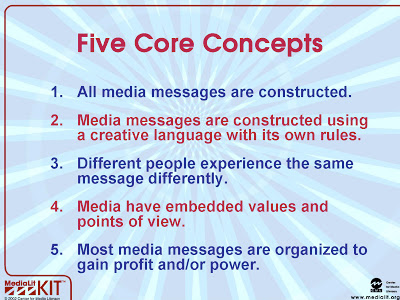
The first is the 5 Key Concepts of Media Literacy.


5 Key Concepts of Media Literacy Poster


The second is the Media Studies Triangle which examines 3 different points of view (the Media Text, the Audience, and the Production) in order to gain more meaning. All 3 points of view must be considered to fully understand the media text's meaning.


Use the activity sheet Media Studies Triangle to analyse various media text....


Let's analyse a few media texts together.....


A) Here is a Coke Commercial.....


B) Here is a PSA (Public Service Announcement) About Factory Farming Called "The Meatrix":


C) Here are Movie Posters.....


D) Now, with a partner or on your own, try using the "Media Studies Triangle" to analyse a Magazine....


Tuesday, September 9, 2008

Lesson 3: Introduction to Unit One CONFEDERATION

Unit One – Confederation -Sept. 2nd to Oct. 10 (6 wks.)
Introduction:
The idea of "national pride" is important. Countries like the United States, India, Italy and Turkey teach their children about the importance of when their country gained independence or united a group of provinces or states to form a country. Most countries in the world are very proud of the formation of their country.

Do some quick research on the internet to find out when the country/countries your family came from either gained independence from another country or united to become a country. For example, using the CIA World Fact Book, one learns that:

Italy became a nation-state in 1861 when the regional states of the
peninsula,along with Sardinia and Sicily, were united under King Victor EMMANUEL
II.

Take the time to research and post results on this blog.

Like these other countries, Canada has an important history of unification (called Confederation) and it is important that we study why the various provinces united when they did. Canada is a great country (one of the greatest in the world) and we as citizens need to know some of it's basic history.

Sunday, August 31, 2008

Grade 8 Geography

GRADE 8 GEOGRAPHY
LONG RANGE PLANS, LESSONS AND TIMELINE


Introduction to Geography:

1) Set-up Duo Tang; Course Outline; Evaluation; and Title Page (Art Mark)

Give out Duo Tang with blank paper (title page)

Title: Geography; students will use the textbook and course outline to design a colourful and creative title page which show all 3 Units in words and pictures.

Give out Course Outline with Evaluation


Unit 1 –Patterns in Human Geo. - Feb. 2ND to March 13 (6 wks.)

Introduction:

Use the Toronto Star articles about this summer's propane explosion to introduce the importance and relevance of land use patterns (i.e. residential beside industrial).

Overall Expectations:
*8G1 identify and explain patterns in Human Geography and describe how human activities are affected by these patterns (Chapter 3).
8G2 demonstrates an understanding of employment patterns and trends.
8G3 use a variety of geographic representations, tools and technologies to gather, process, and communicate geographic information.

Key Question:

Identify and describe the Six Uses of Land and be able to provide examples of each.

Online Activity:

Play SimCity Classic Online and Write a Reflection about what went well and what you would do differently. You are the mayor of your town and you are seeking re-election; write an election speech about what you have done well for your town and what you plan to do in the future.

Evaluation:

Participation in Game; Population of City; and Unit Test

Resources:

Toronto Star article “Riddles in the Ruins”
BLM #2 "Information Organizer" (use one for each Unit for each Key Question).
Textbook Human Geography Chapter 3
SimCity Classic Online Game http://simcity.ea.com/play/classic_instructions.php
SimCity and PowerPoint Lesson Plan


Unit 2 – Economic Systems - March 23 to May 8 (7 wks.)

Introduction:

Introduce unit with Canadian Geographic: A Developing World Poster; an interactive map with lessons is also available online.
Break down GDP to wage per day to help students understand economic condition of a country (i.e. How long would it take a worker in China to buy the Xbox they make?)

Overall Expectations:
*8G22 demonstrate an understanding of economic systems and the factors that influence them.
8G23 describe the economic relationship between Canada and the global community
*8G24 use a variety of geographic representations, tools and technologies to gather, process, and communicate geographic information (Chapter 8).

Key Question:

What are the various ways we measure the wealth of one country compared to others?

Project:

Research Presentation Determining One Country’s Quality of Life (HDI) with 3 Other Countries. Of the three other countries (they pick one, I give them one, and all use Canada). Consider: Human Development Index, GDP, Literacy Rate, Life Expectancy, etc...

Bonus: What would you include to determine a students quality of life in a country? (see question 9 on page 165).

Resources:


World Poster (Canadian Geographic: A Developing World)
BLM #2 "Information Organizer" (use one for each Unit for each Key Question).
Textbook Human Geography Chapter 8
CIA World Fact Book Online
Canadian Geographic: A Developing World Online Map

Evaluation:

Participation, Presentation, and Definitions Test


Unit 3 - Migration – May 11 to June 25 (7 wks.)

Introduction:
Use a slide show of immigrant photos. Have students identify all the examples of people having moved from one place to Canada. Ask them why these people would leave a place (push factors) and why they would move to a place (pull factors).

Overall Expectations:

*8G40 identify factors that influence migration and mobility (Chapter 11)
8G41 demonstrate an understanding of the ways in which cultures are affected by migration
8G42 describe patterns and trends in migrations and their effects on Canada.

Key Question:

Why do people move? What are the “push” and “pull” factors?

Activities:

Map and Globe Skills: Do Lesson “Where Canadians Come From” with Question 6 on page 227 with the class.

Have students interview an immigrant from their family and Create a Report or Learn About Why Your Cultural Group Came to Canada and When? Create a Report.
Options: Written Report, Photo Story or Video Interview.

Resources:
BLM #2 Information Organizer (use one for each Unit for each Key Question).
Textbook Chapter 11
Teacher’s Guide Chapter 11

Evaluation:

Participation, Project, and Test on Push Pull Factors.