If you click once on the page it will get bigger.
Page 16

Page 17

Page 18

Page 20

Page 24

Page 25


Poster C:


Poster E
Poster F:
Poster G
Poster H:

First, do google image searches for varous photos and pictures relating to your group. Save these photos in a folder in your home drive.
Next choose a photo of your native group's environment for the background of your poster. Open this photo in Photo Shop and be sure to resize the image to 11" X 8.5".
Use the text tool to type in the title (Name of Your Native Group and their Way of Life) in a large font, any key words in a medium font, and your name in a smaller font.
Finally, add some smaller photos from the Natural Resources and Basic Needs pictures you have saved in your folder.
Organize your poster in a creative, informative and attractive way.
Here is an example:

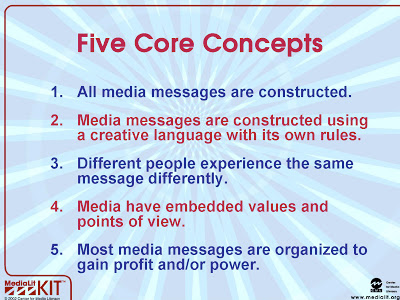
This term we have looked at 3 Media Literacy Concepts:
Choose one of the concepts and use Microsoft Word OR Photoshop Elements to create an 11" x 8.5" poster informing young people about "What Media Literacy means to you?"
Your poster will have the words "Media Literacy is...______________"
The illustration(s) and brief statement(s) will illustrate one concept you have learned this term.
The best projects will be printed poster size in full colour.
Here are 3 examples:


 Here is a great website to find the different brands that appear in the movies!
REMEMBER TO BE AWARE OF THE PURPOSE AND INTENDED AUDIENCE WHEN CREATING A MEDIA TEXT!


The second is the Media Studies Triangle which examines 3 different points of view (the Media Text, the Audience, and the Production) in order to gain more meaning. All 3 points of view must be considered to fully understand the media text's meaning.
 Use the activity sheet Media Studies Triangle to analyse various media text....
Let's analyse a few media texts together.....
A) Here is a Coke Commercial.....
B) Here is a PSA (Public Service Announcement) About Factory Farming Called "The Meatrix":


D) Now, with a partner or on your own, try using the "Media Studies Triangle" to analyse a Magazine....
Italy became a nation-state in 1861 when the regional states of the
peninsula,along with Sardinia and Sicily, were united under King Victor EMMANUEL
II.


Italy became a nation-state in 1861 when the regional states of the peninsula,
along with Sardinia and Sicily, were united under King Victor EMMANUEL II.


Canada's biggest stationery supplier Staples Business Depot is also trumpeting
price cuts on basics such as pencils and paper notebooks.
But consumers hoping to find real deals on a wide range of products during the second-biggest shopping season of the year may be disappointed.
Many Canadian retailers are still charging significantly higher prices than their U.S. counterparts despite last year's sharp rise in the relative value of the loonie, said Doug Porter, deputy chief economist with BMO Capital Markets. (Toronto Star August 19, 2008).This means businesses all what some of our Back-to-School dollars. The question is what will they do to get it?
"The first few weeks of school are an exciting and anxious time for the middle school students. The need for acceptance among their peers can be overwhelming as students strive for a social identity. What students choose to wear to express their identity is a very important influence in social acceptance. Many schools are also faced with the choice of wearing uniforms. Therefore, a study of back-to-school fashion is an ideal starting point for media studies."
Key Questions for Discussion:
- which media influence the choices students and/or parents make about Back-to-School purchases?


Do a YouTube search for "Behind the Screens".... the documentary is in 5 parts on YouTube. Be sure the students are aware the three ways in which products are integrated into the movies we watch today (Cross Promotions, Merchandising, and Tie-Ins). All three are explained with examples in "Behind the Screens: Hollywood goes Hypercommercial 3 of 5" on YouTube.
Cross Promotions: the product is in the film and mentioned plus the commercials about the product mention the film.
Merchandising: what else can you sell as a result of the movie (i.e. t-shirts, mugs, toys). Some characters in movies are actually created because they can easily become toys (i.e. "ToyStory")
Tie-Ins: the product and the film have an agreement/arrangement. For example, Disney and McDonalds have had a 10 year agreement that any Disney movie will be promoted with products (toys with Happy Meals) at McDonalds. Movie makers are nolonger interested in making great movies they are more interested in making great deals.
Product Placement Activity:
Have the students find their own examples of product placement in movies they know. If possible some may even bring in the VHS or DVD. It might be more productive (and provocative) to have them review a few of their own favorite movies. Ask the students to find examples of Cross Promotions, Merchadising, and Tie-Ins
Resources:
YouTube Behind the Screens
Behind the Screens Study Guide
Pruduct Placement Assignment
Major Media Literacy Product for Term One
POSTER CONTEST
This term we have looked at 3 Media Literacy Concepts:
Choose one of the concepts and use Photoshop Elements to create a 7" X 5" poster informing young people about "What Media Literacy means to you?"
Your poster will have the words "Media Literacy is...______________"
The illustration and brief statement will illustrate one concept you have learned this term.
The best posters will be printed posters sized in full colour.


